
Granted charitable status in December 2020, Nature's SAFE is one of Europe's first charitable living biobanks dedicated to storing tissues from animals threatened with extinction. Tullis Matson talked passionately and informatively about the threatened extinction of 42,100 species and how this wildlife conservation charity aims to safeguard our planet's wildlife for future generations . Tullis introduced us to the fascinating world of preserving genetic material through semen and embryos, and the freezing of tissues from endangered breeds. Tullis has worked in the equine industry since 1985 and established Stallion AI Services in 2000. Tullis's journey from leaving school without any qualifications to running a multi-million, award-winning group of companies is testament to his power of determination to dedicate himself to protect endangered species and thus make a difference to the planet.
"The definition of magic is defying logic". This is what Pete Turner told us in his electrifying and thoroughly intriguing talk entitled 'Through the Eyes of a Magician'. Pete's fascinating presentation was full of demonstrations, experiments and clever mind-games making us see things that aren't really there. We were baffled, bamboozled and thoroughly entertained during this humorous and light-hearted talk. Pete was rewarded with rapturous applause from a delighted audience.
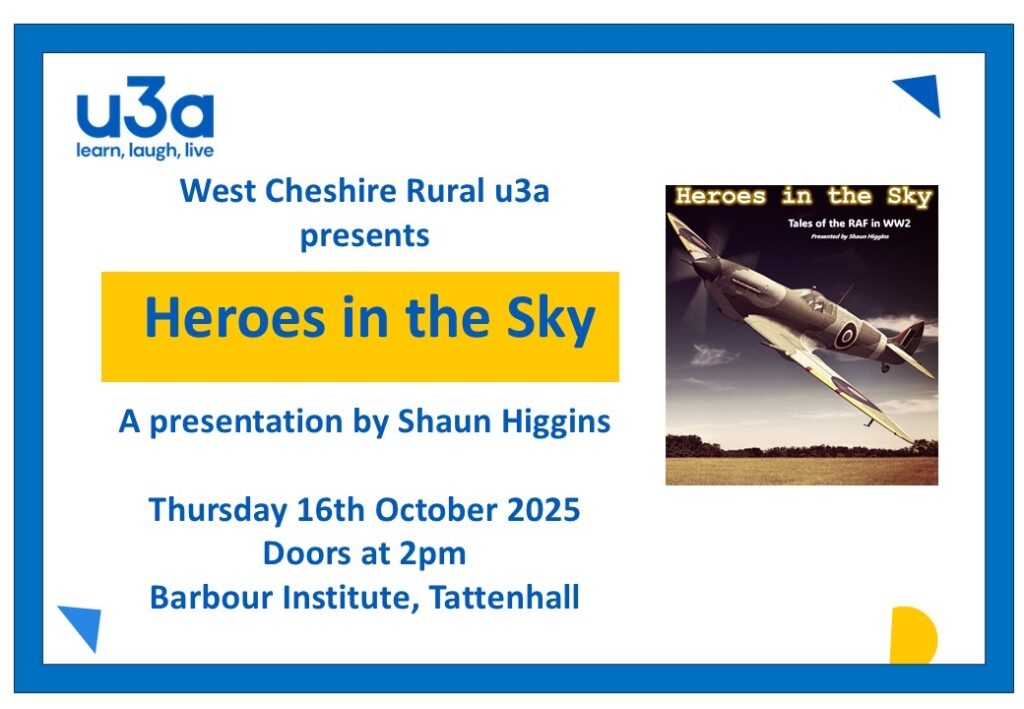
Following his well-received monologue as a WW1 soldier, we invited Shaun Higgins back to talk to us once again. His talk this time was entitled "Heroes in the Sky" and was about the RAF in WW2. He was in character as a pilot, addressing 'his audience of trainee pilots" at RAF Bridgnorth. He mentioned local people, brought out photos and spoke about their experiences. A quarter of a million women served in that war, some flying over 1,000 different planes but they were never given their pilots' wings. Many of us didn't know of the 'Flying Nightingales' (nurses who were flown into active war zones). Shaun also mentioned the huge contribution of the Polish pilots. His talk was wide-ranging and touched everyone in the room bringing forth memories of friends. Many of us wiped away a tear during his amazing presentation.
Neil Hanson gave a spellbound audience a privileged glimpse into the hidden worlds of his ghost-writing clients, some famous and some not so famous. It was a fascinating talk, excellently presented and enjoyed by all.
Neil is a successful author with over 70 published books to his name. As well as his own much acclaimed works, he is a 'ghost-writer' whose clients include household names as well as many less celebrated men and women who have led extraordinary lives or achieved remarkable things. Among many others they include SAS men, fast-jet pilots, explorers and adventurers.

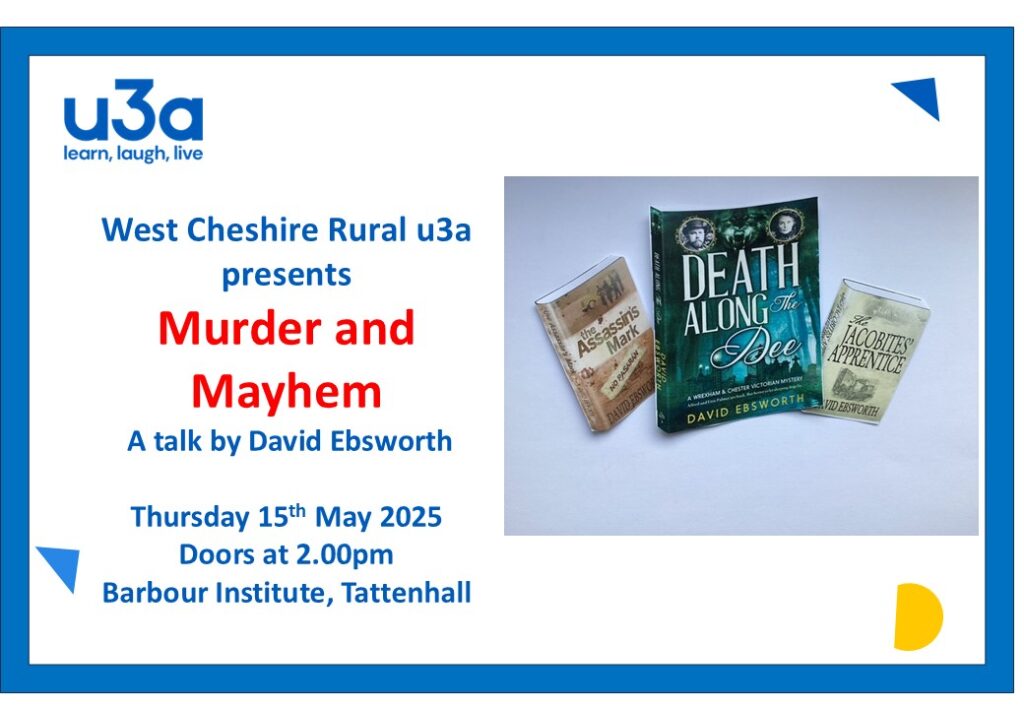
This month's highly entertaining talk was by Dave McCall, a local author of historical crime novels set around Wrexham and Chester under the pen name David Ebsworth. Born in Liverpool but living in Wrexham, David's 14 historical thrillers are set against backgrounds as diverse as sixth century Britain and the Spanish Civil War. His talk "Murder and Mayhem" gave a fascinating (often gruesome) insight into the mind of an author. Dave's tales included death by the common adder; murder by lion; the unfortunate case of a woman being embalmed while alive after mistakenly being given a formaldehyde drip instead of saline; murder by mushroom and even death by paternoster lift. Stranger than fiction? Not at all. Dave told us his books are meticulously researched and based on true historical cases. His Yale trilogy, for instance, tells of Elihu Yale (a celebrated figure from Welsh history). The House on Hunter Street is the saga of a fictional Welsh family caught up in the political turmoil of Liverpool in 1911. Blood Among the Threads is another gory historical crime story, this time set in Wrexham in 1876. This was a most engaging talk and the audience was spellbound.
Our talk in January was by Ron Hutchinson who told us
amusing anecdotes relating to his role of chauffeur to Viscount Leverhulme for 26 years. He described driving several Rolls Royce, horse racing, shooting parties, royal
visits, and an insight into the interactions of high society. A real touch of Downton
It was a great talk enjoyed by all who attended.
In recognition of Armistice Day, we listened spellbound to a performance from Shaun Higgins, as the First World War poet Wilfred Owen, talking about his all-too-brief life. Dressed as a second lieutenant in the Artists' Rifles' brigade Wilfred spoke of teaching in France before the war, then fired by patriotism and encouraged by Kitchener's posters he joined up. However, the reality proved to be horrendous and he ended up at Craiglockhart Hospital with shell-shock. He formed a friendship with Siegfried Sassoon who encouraged him to continue writing his poetry. Owen's poetry captures the true horror of war. Shaun's story told of one soldier's experience yet he spoke for every soldier who had endured the hell of that war. Many of us were visibly moved by his words and the loud applause when he ended was testament to the power of his speech.


Nicky Patterson was an engaging speaker who gave us an interesting insight into the day in the life of her job as an Air Traffic Controller at Manchester Airport. The prime role of an ATC is to manage the flow of aircraft, guiding pilots and monitoring aircraft as they travel to ensure there is 'a safe, orderly and expeditious service to aircraft'. ATCs typically work six shifts in a row followed by four days off and it goes without saying ATCs need to be calm and quick-thinking at all times; there's no room in the control tower for chaos and shouting. While the role of an ATC is currently male-dominated, ATCs are respectd regardless of gender, age, race or relition. Nicky was a generous speaker and responded enthusiastically to the many questions raised by a larger-than-average audience.
The Germans torpedoed the Lusitania in May 1915 because they believed, wrongly, that it was carrying munitions. In fact, the Lusitania was a non-military ship. Conspiracy theories abounded spilling over into anti-German riots, the destruction of long-established German owned businesses in England and the internment of German families in camps. A poster campaign was launched urging people to enlist in the armed forces to strike a blow for those 1198 passengers killed or drowned in the afternath of the torpedoing. Mike Royden gave a detailed and illustrative account including a brief family history of Henry Bowen who was a fireman on the ill-fated ship, as well as many other fascinating facts.


Coral Greenwood describes herself as "a really sad ex-drama teacher" whose love of Shakespeare can never be "too much of a good thing". As she said in her talk, many every-day phrases are quotes from the Bard himself. Shakespeare's writings greatly influenced the English language and many of his words and phrases became embedded in the English language particularly through Samuel Johnson's dictionary which quoted Shakespeare more than any other writer. Shakespeare expanded the scope of English literature by introducing new words and phrases experimenting with blank verse and also introduced new poetic and grammatical structures. In all his works Shakespeare uses 17,677 words and of those 1,700 were first used by him. Coral's interesting and amusing talk ended with a few brave members enacting a prologue of a Midsummer Night's Dream to convey how a play can be summed up in a few lines.


We were highly entertained by Christine Stockton's detailed and comprehensive history of the five stages of the growth of Flamenco in Spain, which started in Andalusia around 710. Originally ruled by the Islamic Moors, Christianity and Judaism were also tolerated. However from the 9th century Spain was gradually re-conquered by the Christians, Granada being the last of the Moorish kingdoms to fall. Expulsion of Jews and Moors followed; those who didn't want to leave went to live with the gypsies. Around this time, following Christopher Columbus's discovery of the Americas, slave-trading began and many people of African heritage also escaped to join gypsy groups. Christine gave detailed information on the growth of Flamenco from the Cante Jondo, through Siquiriya, Solea, Tangos, Fandangos and Ida y Vuelta (the more familiar dances involving fans and shawls). In addition to the fascinating slide-show, Christine herself showcased many of the dances with lively dramatic demonstrations. Her enthusiasm for her subject was boundless and highly entertaining. A great show!


On Thursday 18th January we were treated to a highly entertaining talk by Simon Michael, a barrister who has drawn on is experiences in court to write several best-selling crime novels. Mr Michael was both amusing and erudite, as he told us of his rise from the east end of London to becoming a barrister in Middle Temple, one of the four Inns of Court in the city. His talk was peppered with fascinating facts about the Middle Temple itself, his confrontations with the notorious Kray twins and the dreadful racism he experienced in his first chambers, where he was called, amongst other things, a 'Jew Boy' and was the victim of those more senior barristers, who refused to let him take their 'returned' cases because of his less-than-privileged background. Simon Michael's talk was very amusing and enlightening, particularly about police corruption and politicians' bad behaviour. The audience was left wanting more...